

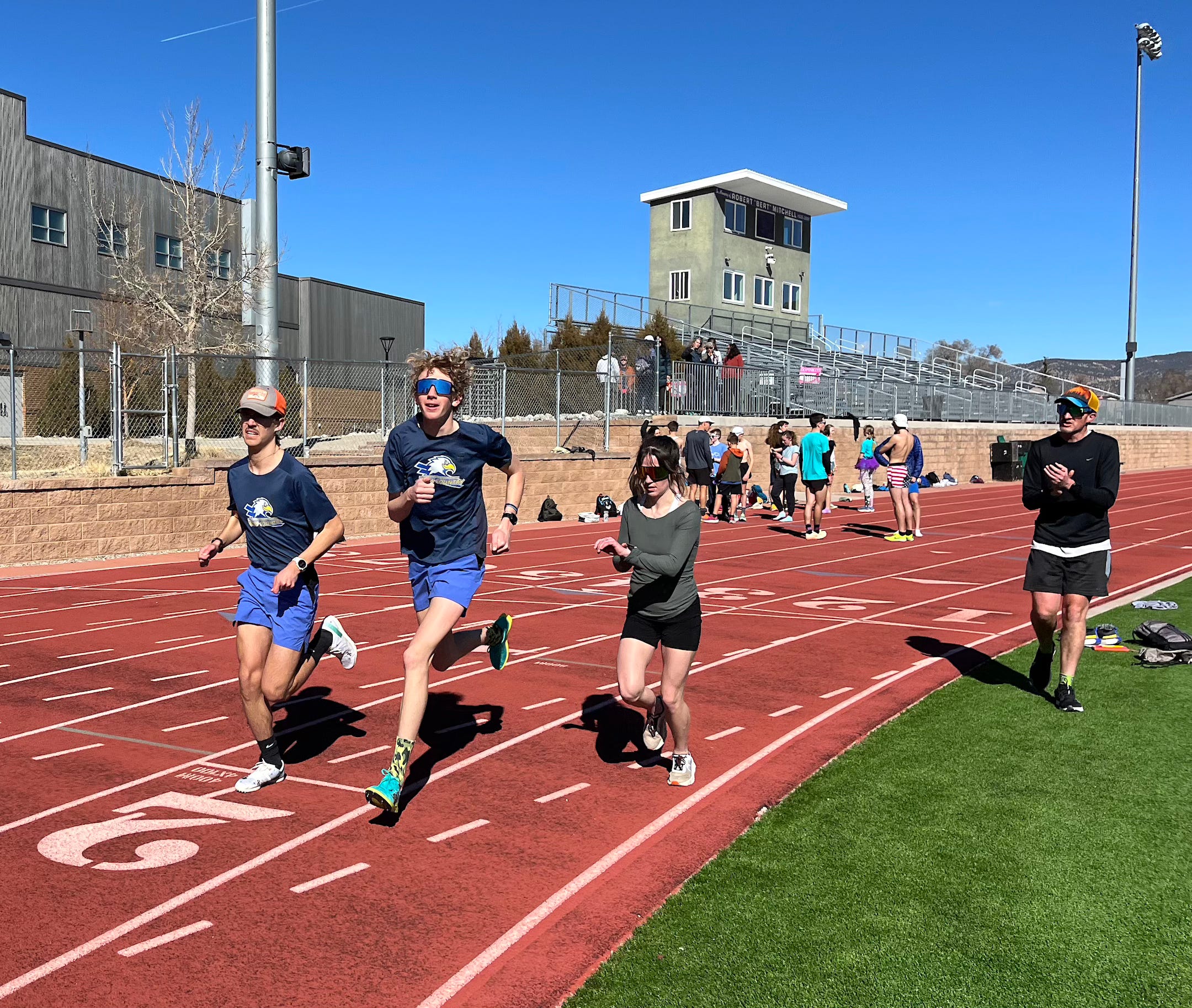
The first two weeks of March were cold and snowy, making track training difficult in the lead-up to the first meet of the season. Since Leadville has no proper track, Darren made plans for some Friday workouts at Salida High School, which is also adjacent to CMC’s Salida campus.
Salida is on our way home, so having practice there on Fridays was ideal. At an altitude of 7,000 feet, workouts there allowed for better leg turnover than downhill time trials at 10,000 feet in Leadville. Plus, the weather was typically warmer, and the track is nice, though not known for especially fast times. Seven thousand feet is still pretty high. Researchers have found the effects at 7,000 feet to be twice those at 5,000 feet!
Of course, Harrison was not happy about riding with me instead of on the team bus. On our first trip, he seemed fine during the drive. However, when Darren drove up with the rest of the team in the van, Harrison began acting strangely, and I had a difficult time getting him to integrate with his teammates for the warmup, change into his track spikes, and get onto the track.
A morale-boosting surprise was Ben from the previous year’s team joining in the workout. After a group warmup, Darren divided the team into shorter and longer distance runners. For the 5K and 10K runners — Harrison, Nate, and Zoe — it was a three-mile warmup, four 1200-meter intervals with equal-time rest, then a three-mile cooldown — about nine miles total. Once Harrison was on the track, he settled down and had a decent workout. After lunch with the team, we headed home for the weekend.
Sometimes Harrison called mid-week for help with course assignments. In these cases, he liked to use FaceTime. It was good to see his face while tutoring him. Undoubtedly, being his dad, aide, and tutor over the past couple of years had become a point of irritation between us. He did not seem to have this issue with either Christie or Nate. I’d noticed that things often went better over FaceTime than working with me in person. He seemed to be more cooperative and pay better attention to his work and my suggestions. Something about the gadget, the virtual buffer, or the disembodied nature of Internet communications seemed to improve cooperation.
In addition, it was usually his idea to FaceTime me for help with his coursework, instead of my suggesting we work on something. One thing I had learned in all my time training animals, especially in pack-burro racing, was that finding a way to make them think it was their idea was key to success. This also seemed to be the case with Harrison. In this way, I helped him stay current on his assignments in English Composition and Interpersonal Communication.
The next couple of weeks would be a whirlwind of activities, including social events, Spring Break, more track workouts, and training runs in spring blizzards, leading up to the season’s first track meet at CSU-Pueblo.
The Blur Goes to College is a free online book published as a series. Subscribe to receive future chapters delivered by email. If you would like to support our writing, we appreciate upgrades to paid subscriptions.